STORY: Olin HydroFleet Wins Farm Robotics Challenge Drone Award
The team from Olin College— who won the Grand Prize for their robot in 2024— took home the 2026 award for Excellence in Drone Applications.
The Olin College Robotics Lab took home the 2026 Excellence in Drone Applications Award in the fourth annual Farm Robotics Challenge awards ceremony on May 21 held at Plug and Play Tech Center in Sunnyvale, California.
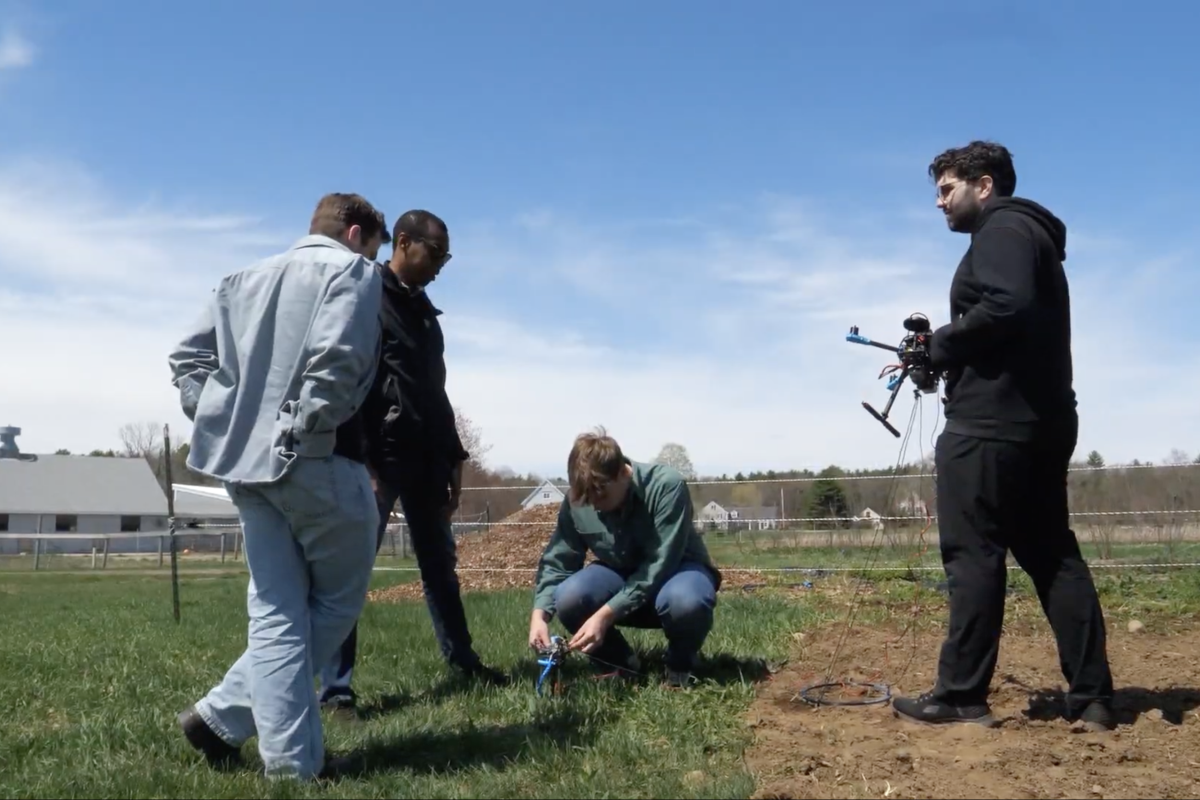
The Olin team designed and built their autonomous drone system, HydroFleet, to quantify soil moisture across a field for irrigation planning. The judges called Olin's submission “the most engineering-mature project they reviewed.”
HydroFleet uses an autonomous drone equipped with a custom soil-moisture probe and a swarm coordination system with sophisticated routing optimization to collect quantitative measurements across dynamically assigned sampling points for irrigation planning.
Led by Kenechukwu Mbanisi, assistant professor of robotics engineering, the team included Olin students Dokyun Kim ’26 (co-lead) and Dexter Friis-Hecht ’26 (co-lead), Zaraius Bilimoria ’28, Heesung Han ’28, Cian Linehan ’27, Swasti Jain ’26, Mehmet Firat ’28, Benjamin Ricket ’28, Grant Rechtin ’28, Pia Swarup ’29 and Kilan Rougeot ’28. In addition to Mbanisi, Harvey Merton served as a graduate student mentor for robotics and autonomous systems.
“I'm incredibly proud to see my students' hard work receive national recognition,” said Mbanisi. “It's especially fitting that the judges called our project 'the most engineering-mature project they reviewed,' reflecting what we strive for at Olin College—developing deep technical competency alongside a strong commitment to applying engineering to real-world impact and the common good.”
Olin RoboLab Students Reflect
“Having been part of this lab since winning the Grand Prize in 2024, I am incredibly proud that we secured the Excellence in Drone Applications award this year,” said Kim, whose contributions included developing autonomous behaviors for the drones.
That work involved “writing the software required to execute multi-stage missions: navigating precisely to designated waypoints, descending to collect physical samples, and executing a custom landing sequence specifically designed to protect our soil sampler. Translating these behaviors from simulation to physical hardware proved to be a challenging process,” he explained.
“Code that operated perfectly in simulation frequently encountered unmodeled variables when deployed on the actual drones, leading to many unfortunate crashes during early testing. However, working through these "sim-to-real" gaps was both an incredible learning experience and a satisfying experience. I still remember the first time we were able to run the full mission end-to-end on the actual drone in the soccer field and how excited everyone was,” said Kim.
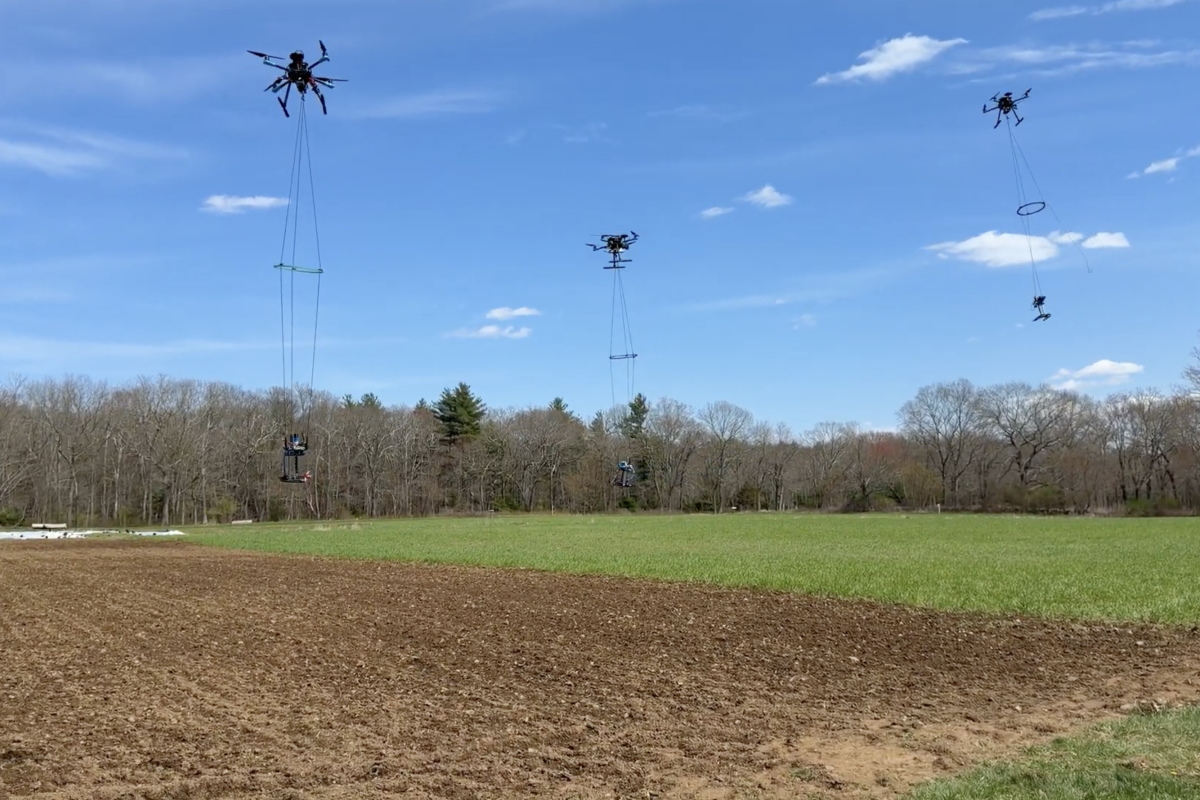
Olin Robotics Lab's Hydrofleet Drones.
Friis-Hecht was also a member of the winning 2024 squad and noted the growth of the lab and evolution of robotics research during his time at Olin. “I'm incredibly proud of all the hard work everyone on the team has put in, and it's a pleasure to do research in a field with clear, tangible benefits for the world.”
Much of his work focused on drone power, flight correction and GPS data, and solving for challenges like weather, wind and flight location. Despite the variables, Friis-Hecht described the project as a “fantastic learning experience.”
“One thing that's always exciting about research is the ambiguity,” he explained. “Each project we've done has been different from the last, and it's up to us to research the problem, scope it, and then learn the skills needed to execute upon the idea. This can lead to bumpy roads, and sudden pivots, but I think it's helped us build essential skills for both real-world and in-academia engineering work.”
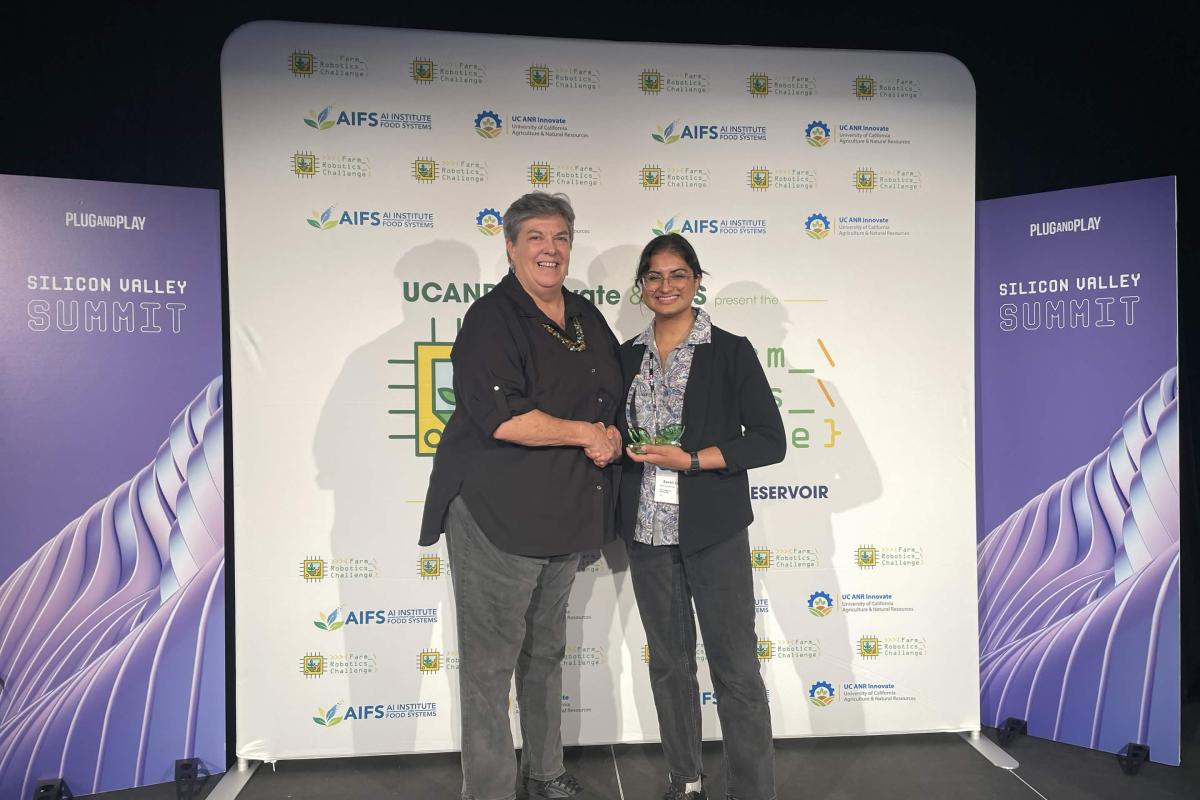
Olin Robotics Lab Member Swasti Jain '26 at the Farm Robotics Challenge Awards Ceremony.
Another team member, Jain, credits the Farm Robotics Challenge and Olin's RoboLab with helping her define where innovation is truly needed in robotics. Having heard that "robots are the future!" throughout her childhood in the Silicon Valley area, this was an opportunity for Jain to explore where that future could lead. “The team has accomplished so much in just a few short months, and it is so inspiring to see that as engineering students, we can create real solutions,” she said.
“But of course, solutions without implementation are just ideas. We could not have seen this idea come to life without the support from our farm partners, Powisset Farms and CBM Farms. Through systematic testing and on-site implementation, this project has shown me that robots can create a genuinely impactful future for agriculture and beyond.”
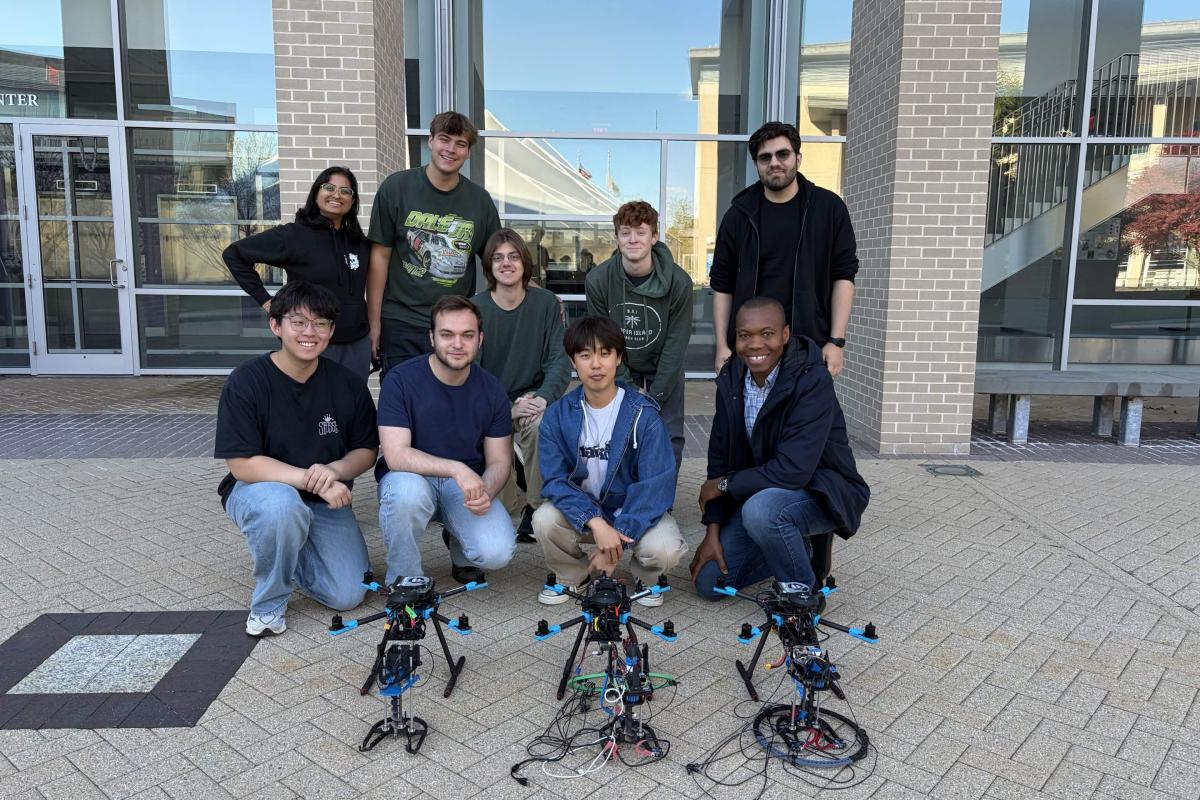
Olin College of Engineering's Robotics Lab Team, winners of the 2026 Farm Robotics Challenge award for Excellence in Drone Applications.
(Not pictured: Pia, Cian, Zaraius and Harvey).
About the 2026 Farm Robotics Challenge
The 2026 Farm Robotics Challenge, hosted by UC ANR Innovate (the innovation arm of University of California Agriculture and Natural Resources) and the AI Institute for Next Generation Food Systems (AIFS), engaged students at many levels of the educational pipeline to tackle critical on-farm challenges including weed management, pest pressure, harvesting, irrigation, scouting and labor shortages.
This year’s competition grew by leaps and bounds, with 96 teams from 13 countries taking part across three divisions: Division I for four-year universities, the new Division II for two-year colleges, and the Farm Robotics Academy for grades 7 through 12. International entries came from Australia, Bangladesh, Brazil, Canada, Egypt, Ghana, India, Lebanon, Peru, Tunisia, Turkey and the United Kingdom.
“The judges consistently remarked that this year’s finalists represent some of the strongest work they have ever seen in this competition, with multiple projects described as investment-ready and commercially viable,” said Kelly Scott, Farm Robotics Challenge director. “These students are not just solving problems; they are building the next generation of agricultural technology.”
Winners were announced across five award categories spanning all three divisions, with more than $100,000 in prizes and awards on the line, including the $50,000 Grand Prize; major division awards for Amiga Innovation, Specialty Crops, Drone Applications and AI; plus travel stipends to the FIRA USA 2026 robotics/automation conference and an opportunity to pitch at Plug and Play. All winning teams and finalists’ videos can be viewed at farmroboticschallenge.ai.
Watch a recording of the livestreamed ceremony and view the winning projects at farmroboticschallenge.ai/2026results.


