STORY: New Report Maps the Future of Robotics Across Africa
As robotics transforms industries around the world, a new report by the African Robotics Network (AfROB) is helping answer a fundamental question: What does the future of robotics look like in Africa? The inaugural State of Robotics in Africa report, which details the nuanced and promising answers, was shared with more than 100 participants from across Africa and the diaspora at AfROB’s June Summit.
Spearheaded by Kenechukwu C. Mbanisi, assistant professor of robotics engineering at Olin and executive director of AfROB, the report offers the first continent-wide assessment of Africa's robotics ecosystem. The yearlong project examines robotics across all five geographic regions, identifying trends, opportunities, and challenges to help researchers, educators, policymakers, and industry leaders better understand the current climate and make informed decisions about the field's future.
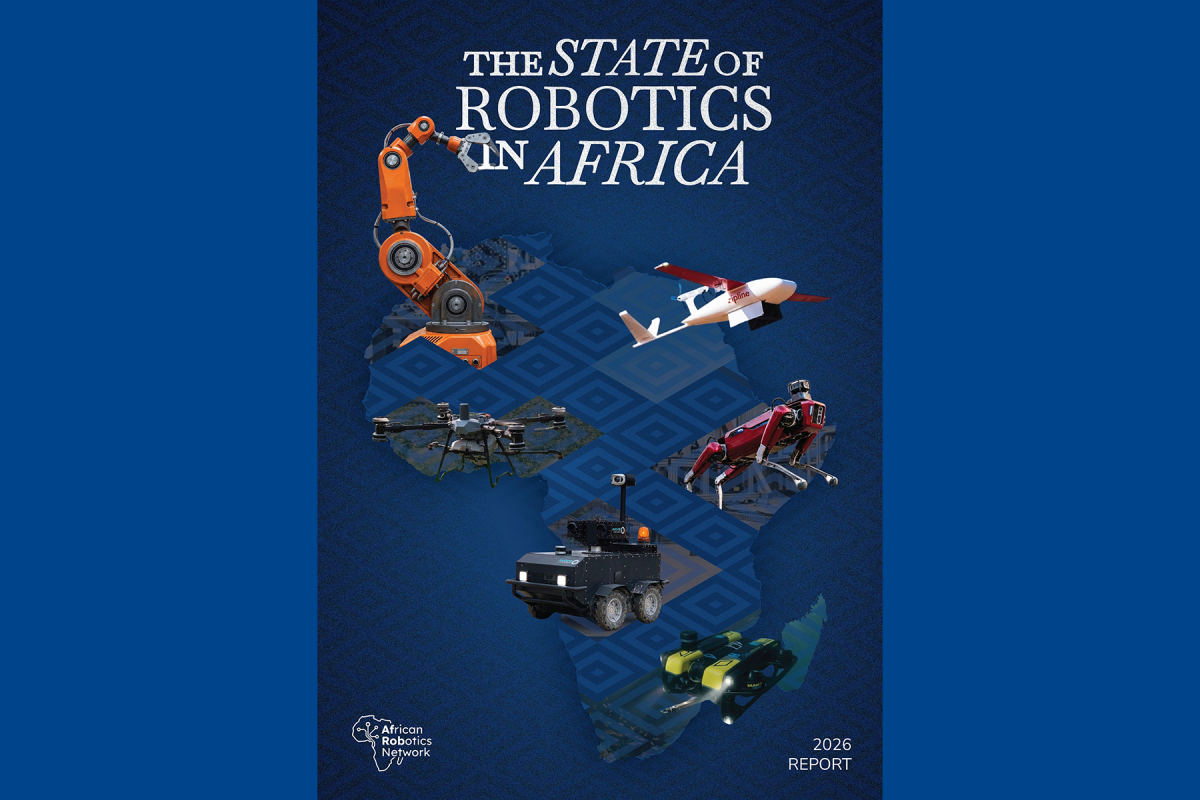
The cover of The State of Robotics in Africa, a report by the African Robotics Network (AfROB) spearheaded by Kenechukwu C. Mbanisi, assistant professor of robotics engineering at Olin and executive director of AfROB.
"Before this report, there wasn't a comprehensive picture of robotics across the continent," says Mbanisi. "Robotics activity was happening in many places, but it was often fragmented and underreported. We wanted to create a resource that brings clarity to the field and helps people understand where collaboration and investment can have the greatest impact."
Founded in 2012, AfROB was created to connect researchers, educators and innovators working in robotics across Africa. The organization's earliest initiatives focused on making robotics education more accessible, including a widely recognized competition that challenged participants to develop low-cost educational robotics kits.
Over the years, AfROB has expanded its efforts through forums at conferences, networking opportunities and partnerships designed to build a stronger robotics community across the continent.
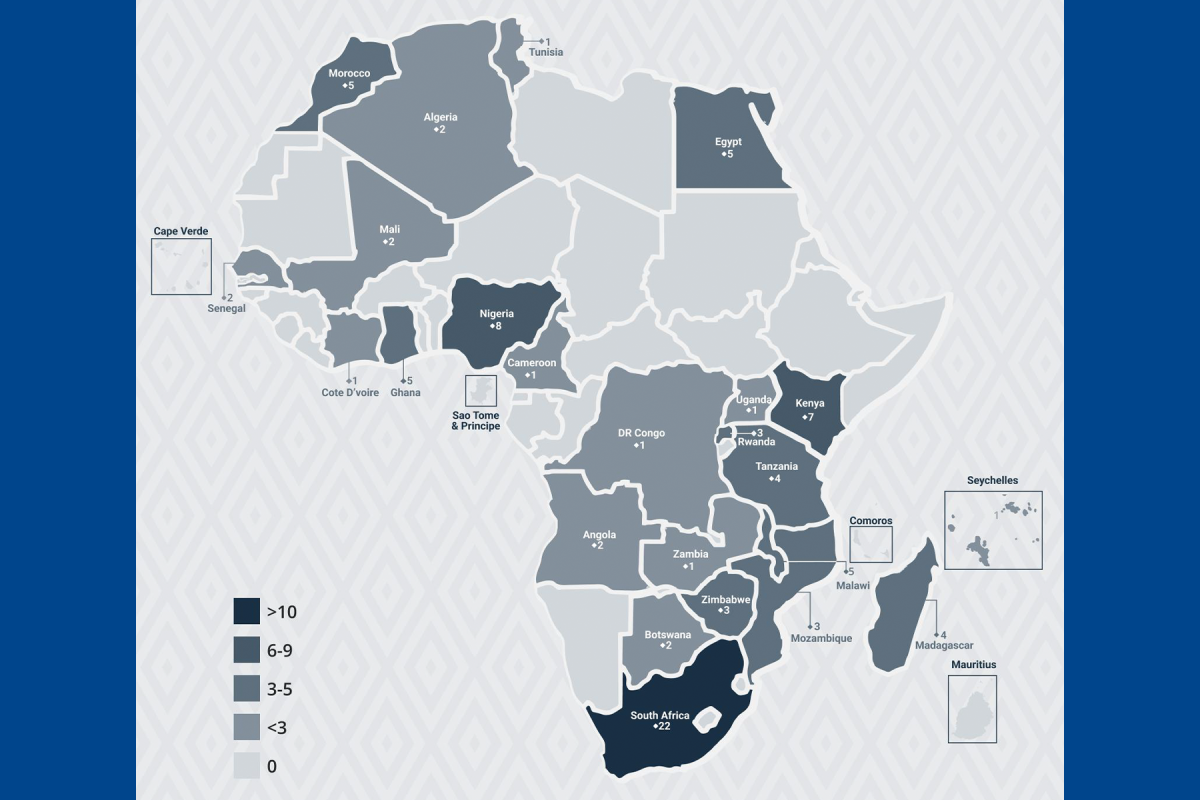
A graphic measuring the adoption of robotics adoption across Africa from The State of Robotics in Africa report by AfROB, spearheaded by Olin professor Kenechukwu C. Mbanisi.
Since assuming a leadership role with the organization in 2024, Mbanisi has helped reinvigorate that mission by focusing on strengthening connections across Africa's robotics ecosystem and increasing the visibility of work already taking place.
The new report reflects that holistic approach. Rather than focusing solely on technological development, the research team examined four interconnected pillars of the robotics ecosystem: industry, talent and workforce development, research and innovation, and policy and regulation. The report combines extensive desk research with interviews from 15 experts across the robotics ecosystem representing diverse sectors and regions across Africa.
"We took an ecosystem approach because robotics isn't just about building robots," says Mbanisi. "It's about the people who develop them, the institutions that educate future engineers, the industries that use them, and the policies that shape how these technologies are deployed."
"We took an ecosystem approach because robotics isn't just about building robots," says Kenechukwu C. Mbanisi, assistant professor of robotics engineering at Olin and executive director of AfROB. "It's about the people who develop them, the institutions that educate future engineers, the industries that use them, and the policies that shape how these technologies are deployed."
Key Takeaways
Among the report's most significant findings is that robotics adoption in Africa follows a different trajectory than in many industrialized regions of the world. While robotics and automation in North America, Europe, and parts of Asia has often been driven by labor substitution, African organizations are more frequently using robotics to expand capabilities and solve locally relevant problems that previously had limited practical solutions.
"One of the most striking things we found is that robotics adoption across Africa is less about replacing workers or cost-efficiency, and more about capability augmentation," says Mbanisi. "People there are using robotics to accomplish things that couldn't be done effectively without the technology, such as healthcare deliveries in remote areas."
Drone-based applications illustrate that trend. Accounting for roughly 40 percent of documented robotics use cases identified in the report, drones are being used for everything from environmental and infrastructure monitoring to agricultural technologies such as crop monitoring and precision herbicide spraying.
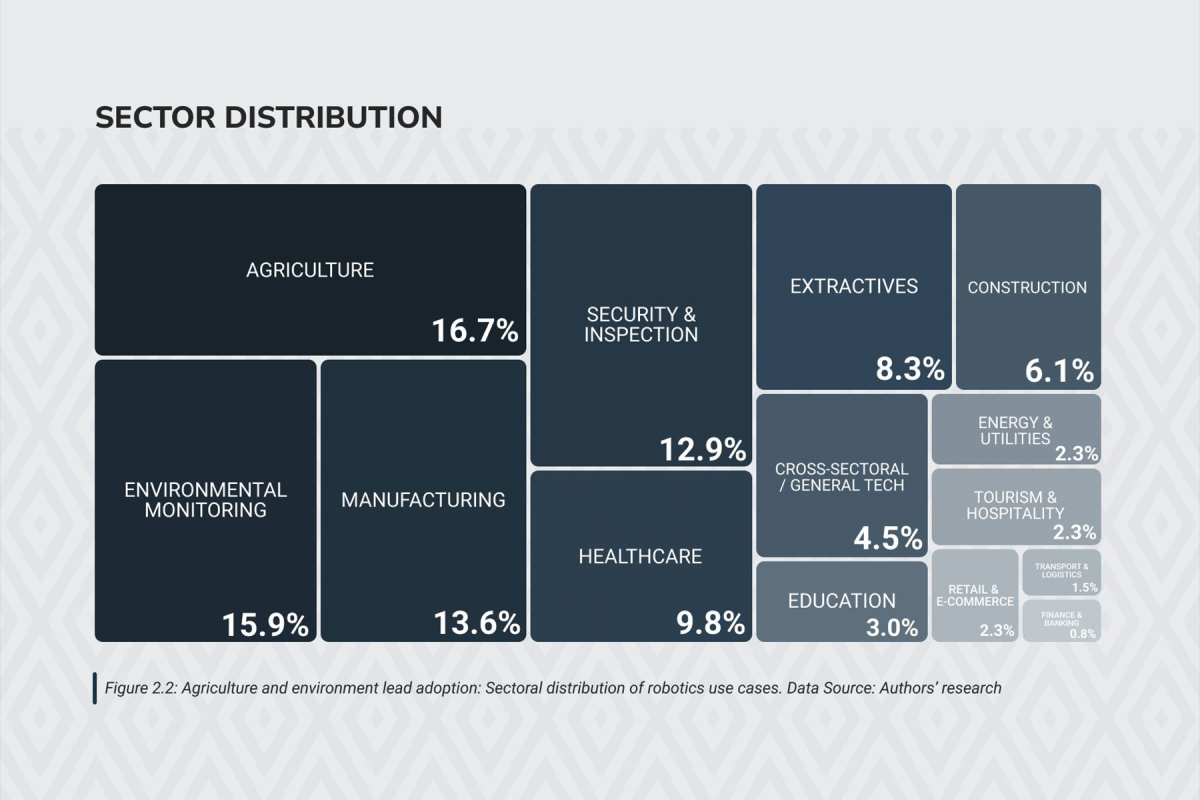
A graphic showing the sector distribution of robotics technology in Africa from AfROB's The State of Robotics in Africa Report.
Connecting Back to Olin
The agricultural robotics use case aligns closely with Mbanisi's research at Olin, where he leads student projects focused on helping small-scale farms improve farming practices and operations through automation. Recent examples include developing a low-cost blueberry sorting robot for a farm in Upton, Massachusetts, as well as two projects that won awards at international Farm Robotics Challenges: a grand prize-winning autonomous weeding robot and an autonomous drone system that can measure soil moisture to help farmers with irrigation planning, which won the award for Excellence in Drone Applications.
Though Mbanisi’s Olin-based research partners are primarily organic farms in New England, he sees strong parallels with farming operations across Sub-Saharan Africa, particularly in West Africa, where small-scale agriculture is also the norm.
"I see opportunities to develop solutions with Olin students that can eventually translate across different contexts, as well as explore collaborative research projects with partners in West Africa," says Mbanisi. "While the climates may be different, many of the operational challenges are remarkably similar."
"I see opportunities to develop solutions with Olin students that can eventually translate across different contexts, as well as explore collaborative research projects with partners in West Africa," says Mbanisi. "While the climates may be different, many of the operational challenges are remarkably similar."
The report also reinforces another area central to Mbanisi's work: preparing the next generation of robotics engineers. In the same way that AfROB works to strengthen robotics education across Africa, Olin is also helping its students learn not only how to build intelligent systems, but also how to consider the broader societal, economic, and policy contexts in which those technologies operate.
For Mbanisi, the report is intended to be more than a snapshot of the current landscape. It is a roadmap for collaboration—and an invitation to recognize Africa's growing role in shaping the future of robotics.
"Our goal is to help people see that innovation is already happening," says Mbanisi. "By getting a broader picture of the robotics ecosystem on the entire continent, we can create stronger opportunities for innovation within Africa and around the world.