STORY: How Olin First-Years Built a Viral Self-Balancing Bicycle (VIDEO)
This bike should be falling over. But it’s not...
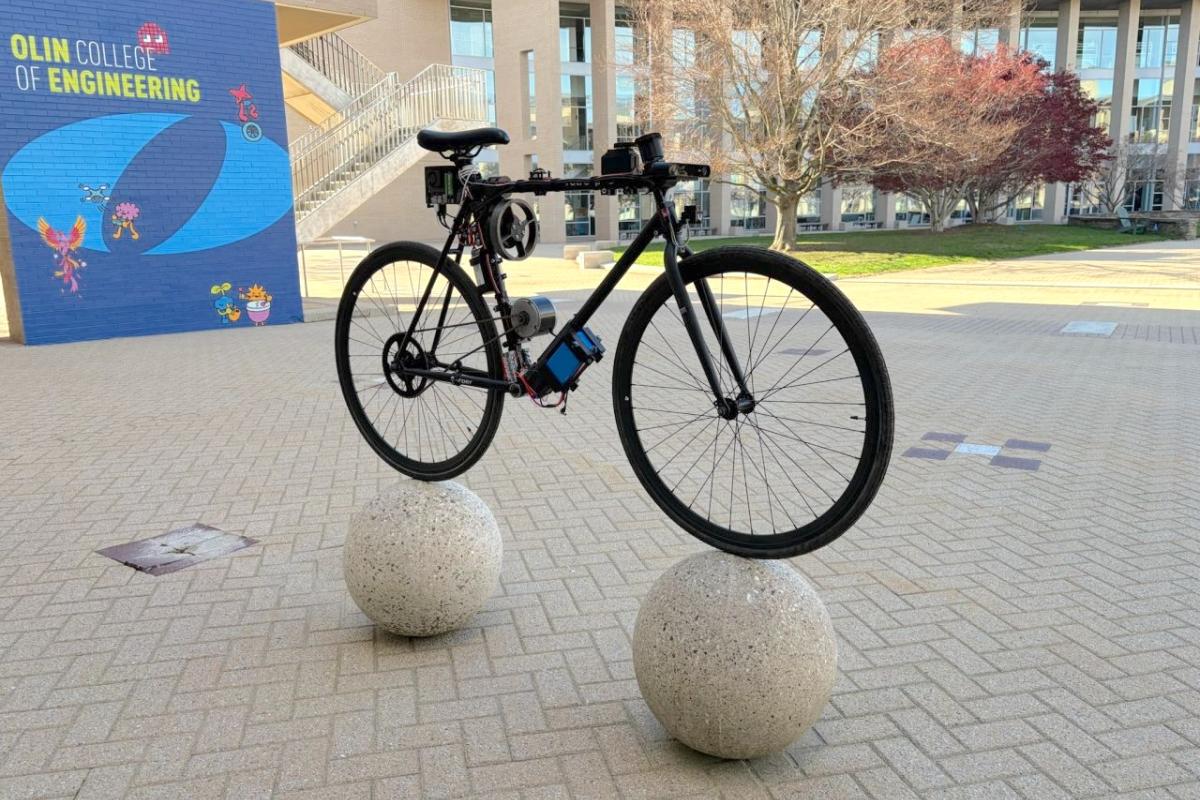
The autonomous self-balancing bicycle built by Justin (Jonghoo) Yoon '29, Pia Swarup '29, and Aryan Banerjee '29, is pictured balancing on the two stone spheres in front of Milas Hall.
That’s because a team of first-year Olin students built it as an autonomous self-balancing bicycle for their Independent Study Research (ISR) project.
Working with field roboticist and Olin alumna, Dr. Victoria Preston ‘16, assistant professor of engineering, as an advisor, this open source research project explores the design and implementation of an autonomous, self-balancing bicycle using a reaction wheel for stabilization.
The system developed by the students combines embedded control, power electronics, and robotic autonomy to achieve balance, perception, and navigation on a dynamically unstable platform. Looking to build a genuinely accessible platform, the bare configuration comes in under $1,000, utilizing 3D-printed components and off-the-shelf hardware.
"This is a project I've had in the back of my mind since high school," says Justin (Jonghoo) Yoon '29, one of the bike's creators.
"Building a self-balancing vehicle was always a fascinating topic for me. With the support and resources that Olin offers for student research projects, I was finally able to make it a reality."
Along with fellow first years, Pia Swarup and Aryan Banerjee, the trio of students were able to build something amazing, plus, the entire project is not only built to be low-cost, it's also a modular platform that other researchers can use for their own research into two-wheeled autonomous vehicles.
Research of a platform that is proving to be of huge interest as a video created by Olin of the bicycle has since gone viral on Instagram, generating over 3 million views, tens of thousands of shares, engagements, and community questions, all in its first few months online.
The Video
The Motivation
An autonomous bicycle requires nonlinear control and autonomous navigation, making it a compelling topic for research and experimentation.
Not to mention, it's a fun project to build from scratch. Which the students did.
Prior work also motivated the team and helped to shape the direction of their build. The Xuan Bike by Peng Zhihui, for example, demonstrated that reaction wheel based balancing was viable on a full scale bicycle, and provided a practical reference for the stabilization approach used in the project.
Google's April Fools video of an autonomous bicycle in 2016 was also an early reference for the idea, says Justin.
What was once just a humorous spoof, 10 years later is now a reality.
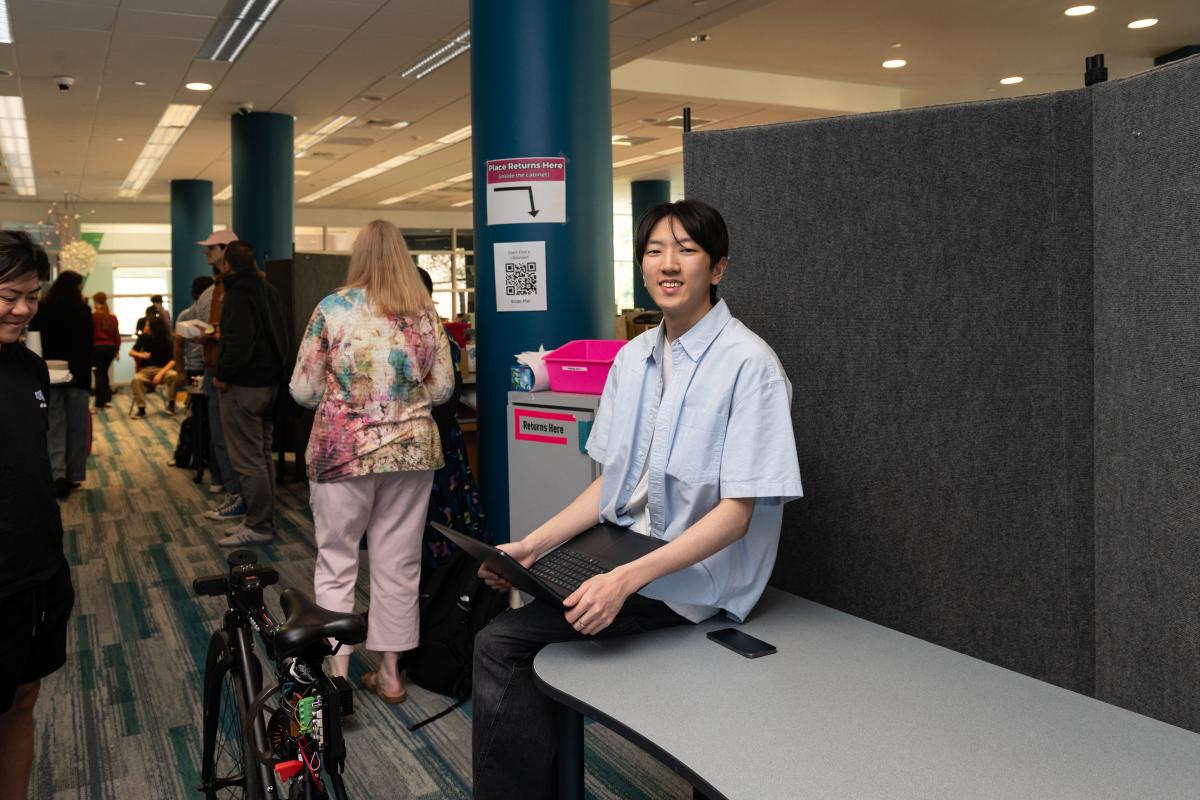
Justin (Jonghoo) Yoon '29, one of the bike's creators, is pictured in the Library during Spring Expo 2026.
The Bicycle
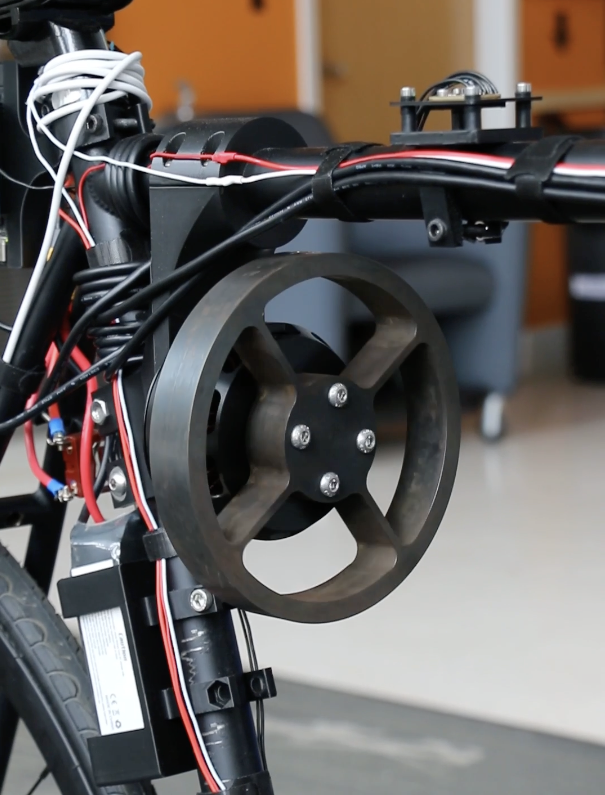
The bicycle uses an active reaction wheel, controlled by an STM32 microcontroller, to generate the stabilizing torque needed to stay upright.
Based on cascade Proportional-Integral-Derivative (PID) control, the inner PID loop continuously reads roll angle from an Inertial Measurement Unit (IMU) and adjusts the angle of the bicycle, while the outer PID loop dynamically corrects the balance point to keep the reaction wheel from being saturated.
Saturation (i.e. reaching maximum designed rotational speed, thereby losing the ability to maintain stability control) of the motor was the main issue the students were facing with the wheel before they initiated the balance point adjustments.
How Does the Bicycle Move?
The bicycle moves using a chain-driven DC motor mounted to the frame, and steers using a high-torque servo motor with a custom bevel gear.
Autonomy is achieved using visual SLAM (Simultaneous Localization and Mapping) with the front-facing ZED 2i stereo depth camera running on a Jetson Orin Nano. An additional 2D LiDAR sensor is used for low-latency obstacle detection.
The most eye-catching parts of the bicycle undoubtably is that it can balance reliably on narrow railings (see video), and is capable of basic autonomous navigation. For example, the apropos phrase, "Ghost Bike!" was excitedly uttered by an attendee at the Olin Spring Expo while the autonomous navigation was being demonstrated.
See the team's research paper: Design and Development of a Modular Open-Source Platform for Two-Wheeled Self-Balancing Vehicles
How'd they build it?
See the bill of materials, CAD files and more
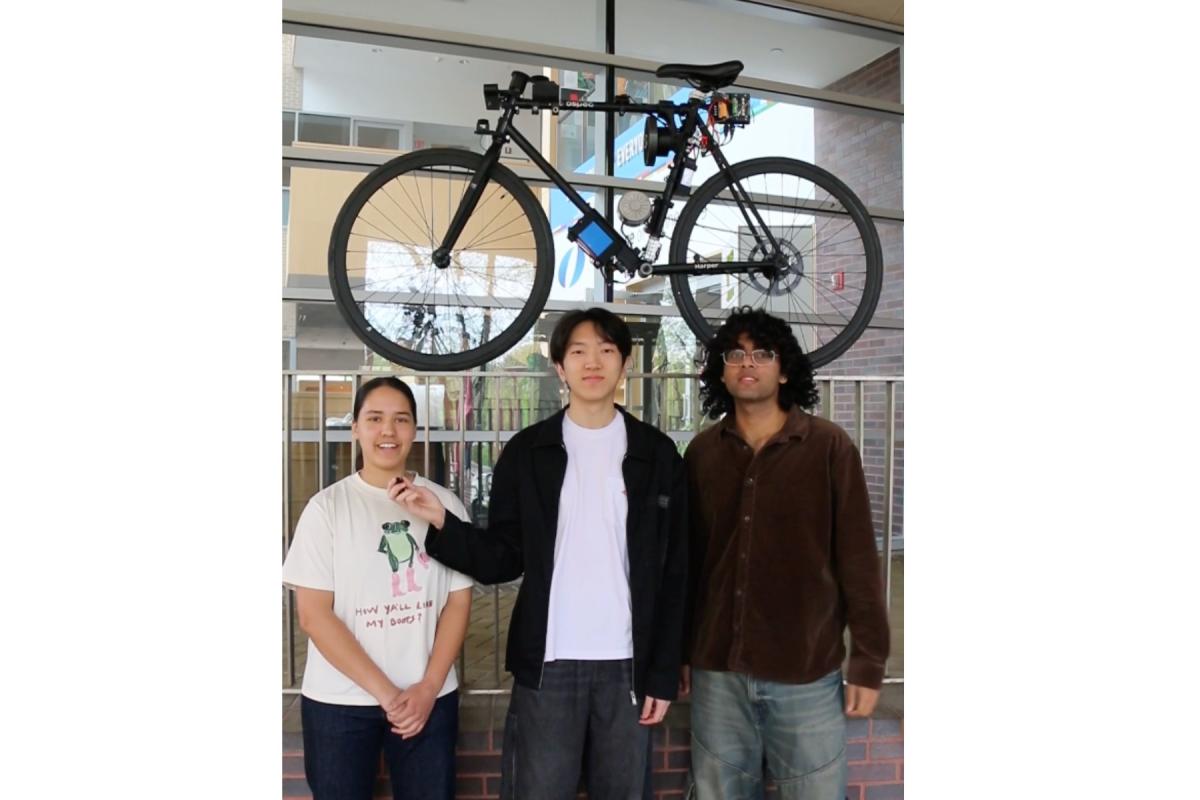
(L to R): Pia Swarup '29, Justin (Jonghoo) Yoon '29, and Aryan Banerjee '29, pose in front of the self-balancing bicycle they built as part of an Independent Study Research (ISR) project advised by Dr. Victoria Preston '16, assistant professor of engineering. Still from video by Adam P. Coulter
What's Next?
In terms of what's next, the team is looking to expand on its autonomous driving capabilities.
"Our next goal is for it to do frontier semantic exploration using SLAM, so it can be dropped into an unfamiliar environment and figure out where to go on its own," says Pia.
The team is also looking at Reinforcement Learning (RL) to allow it to balance using steering and drive control.
"We are currently looking at RL for a hybrid stabilization model that combines steering-based balancing and the active reaction wheel for ideal stabilizing characteristics in both low and high speed scenarios," says Justin.
For the students involved, the project reflects the iterative, hands-on experimentation that defines engineering at Olin. Even after a million views online, the team remains focused on the next challenge: building a bicycle that can not only balance itself, but navigate the world on its own.
Join Our Contact List
Want to receive more information about Olin College and our unique admission process? Use the form below to join our contact list! Students who complete this form will receive emails, invitations to events, and other admission updates from Olin.
Join Us!