Jack-William Barotta has joined the Olin faculty as an assistant professor of applied math. He previously completed his Ph.D. in Fluids and Thermal Sciences from Brown University, where he taught courses on fluid mechanics, art fluids engineering, and dynamics.
A first-generation college student from Florida, Barotta attended MIT for his undergraduate degree, where he studied physics before switching over to mathematics in his quest to discover “what kind of scientist [he] wanted to become.”
“Traditional physics didn’t seem like the right fit for me, but I did enjoy mathematics and the ability to use equations and models to understand the physical world,” says Barotta. “I wanted to be able to model the world around me, things like drops of water on a window."
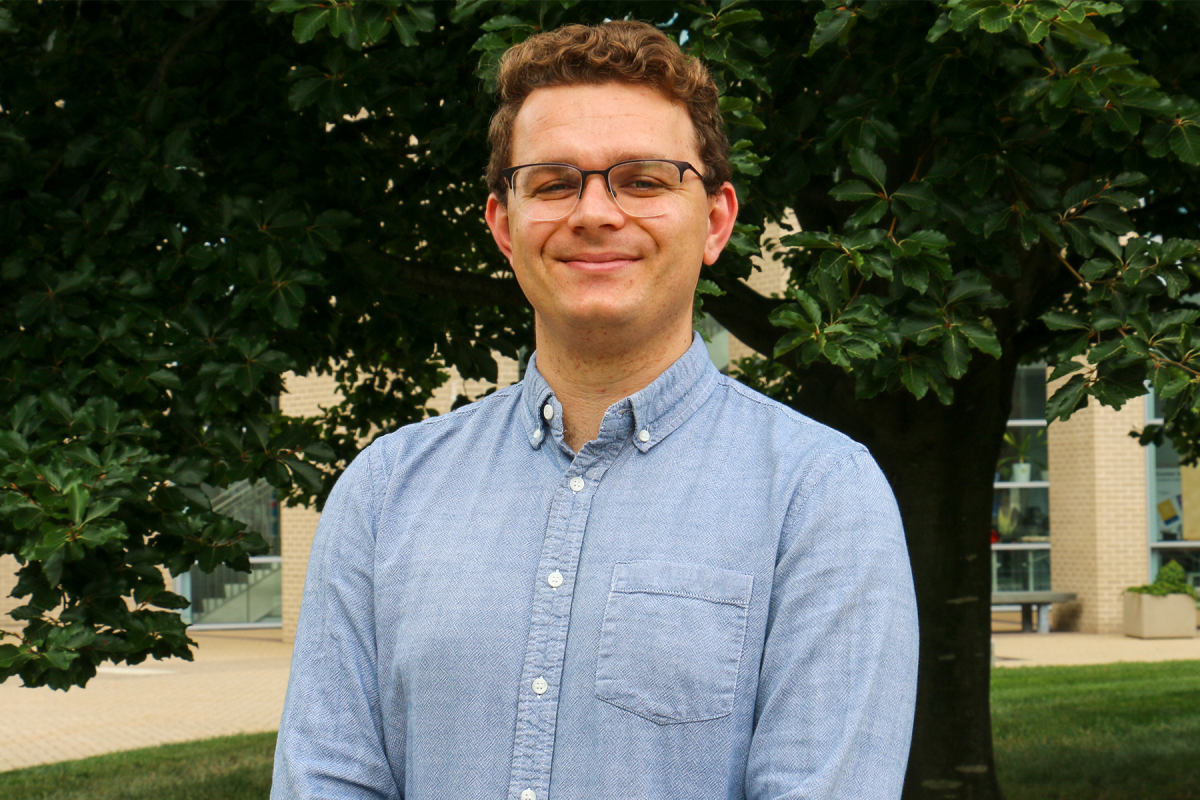
Jack-William Barotta, Assistant Professor of Applied Math at Olin College.
At MIT, Barotta also developed an early passion for teaching by tutoring through the Talented Scholars Resource Room and the Interphase EDGE program. He would later go on to earn an Presidential Award for Excellence in Teaching from Brown for his rigorous instruction, peer support, and enthusiasm for education.
Barotta’s research focus lives at the intersection of mathematics, physics, and engineering, making Olin’s interdisciplinary culture a natural fit. During his doctoral work, he studied a class of “active matter”—small objects that self-propel and interact. His experiments involved placing objects on a fluid surface above a loudspeaker and using vibrations to generate waves. The objects themselves generated and responded to those waves, creating interactions that could cause them to move and synchronize. The work recently earned Barotta the 2026 Emerging Soft Matter Excellence Award from the American Physical Society.
Now, at Olin, Barotta plans to expand that research into larger collections of interacting objects. His new Active Matter and Fluid Mechanics Lab will investigate how collective behavior emerges when millimetric objects interact through a shared fluid medium—the same physics behind familiar examples such as cereal floating in a bowl of milk or the insects called water striders skating on a pond’s surface.
This semester, Barotta will teach Quantitative Engineering Analysis 3 (QEA3), where the curriculum centers on differential equations and mathematical modeling of systems over time and space. The course connects directly to the mathematical foundations of his own research.
Barotta is particularly excited to bring theory into practice at Olin, an aspect that fits his belief that students learn best when mathematical ideas become tangible.
“I’m really excited about project-based learning at Olin,” he says. “Being trained in math, I like being able to take theoretical ideas and bring them into practice.”
“I’m really excited about project-based learning at Olin. Being trained in math, I like being able to take theoretical ideas and bring them into practice,” says Barotta.
Barotta frequently uses relatively inexpensive equipment to turn abstract concepts into visible, engaging experiments, sometimes for children as young as four, to demonstrate how changing a system can produce different physical behaviors.
Barotta and his wife are settling into the area with their cat, Toad. An avid mini-golfer and bowler who competed on his high school’s varsity team, Barotta is particularly excited to be near the local candlepin bowling venue.
Most of all, Barotta says he was drawn to Olin because he wanted to join a small institution where faculty and students really know one another.
“I’m excited to meet everyone and be part of a community,” he says.